






Low-Code vs No-Code: Which is Right for Your Business Transformation?
Did you know the low-code and no-code development market is expected to reach $187 billion by 2027?
As businesses look for faster, more cost-effective application development services, low-code and no-code platforms are helping organizations build applications with greater speed and efficiency.
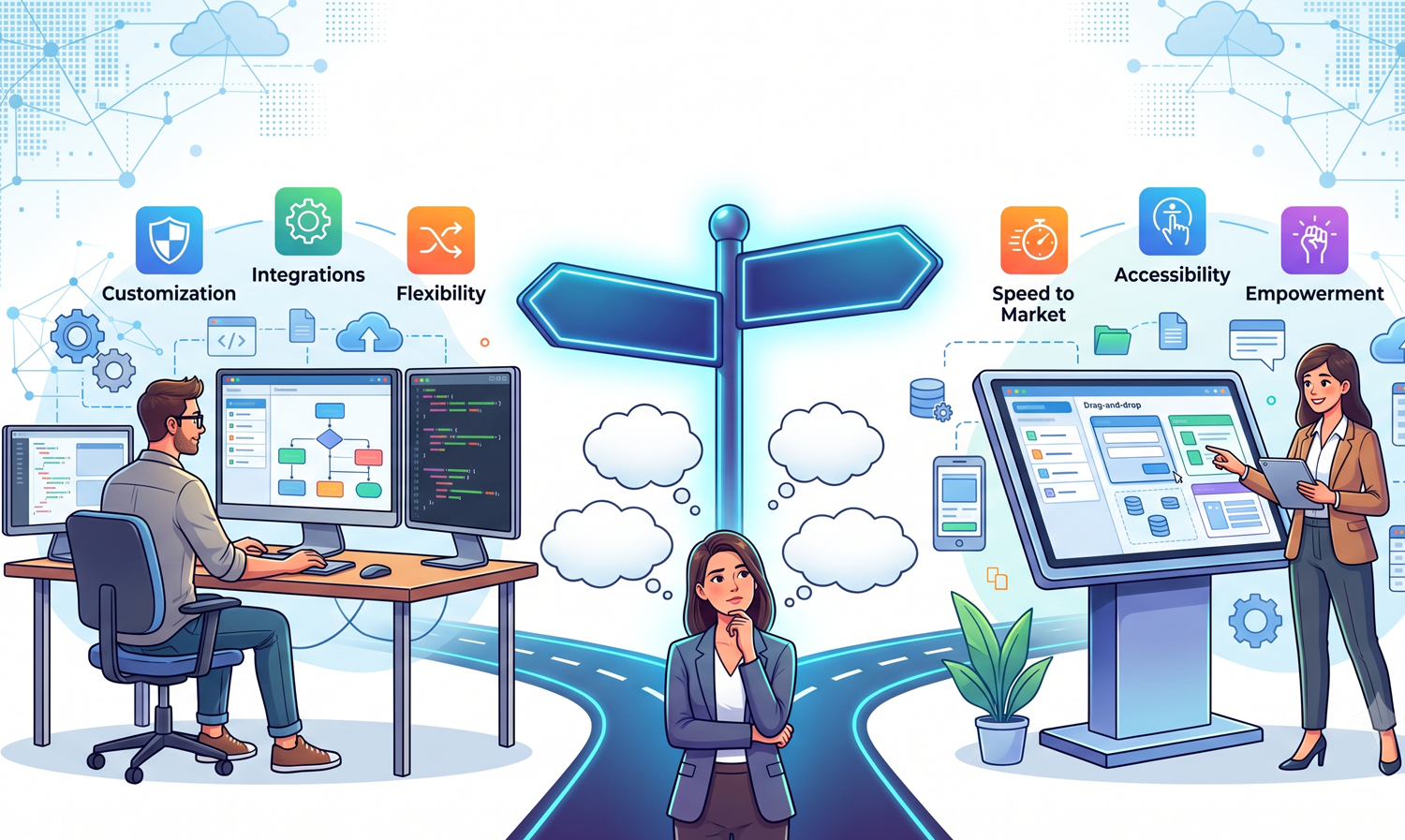
But when it comes to low-code vs no-code, which approach is the right fit? While both simplify application development, they differ in flexibility, customization, scalability, and the level of technical expertise required.
Whether you’re an SMB modernizing operations or an enterprise accelerating digital transformation, understanding these differences can help you choose the right platform for your business goals.
By 2030, the global low-code/no-code market is projected to reach nearly $187 billion, reshaping how businesses build applications.
Understanding Application Development Services
In recent years, application development services have taken a paradigm shift evolving from traditional coding practices into a low-code and no-code approach.
Low-code and no-code platforms fit well with the larger Application Development Ecosystem and have developed into a much stronger tool with high development capabilities that do not depend on major coding skills extensively.
Today, low-code/no-code development is widely adopted as a faster alternative to traditional development, especially for businesses prioritizing speed, agility, and cost efficiency.

Simplifying Complex Processes
Low-code and no-code platforms enable developers and non-technical users to build applications faster using drag-and-drop interfaces and pre-built templates. They complement traditional application development services by streamlining workflows, reducing manual coding effort, and supporting scalable application development.

Enhancing Collaboration
Low-code and no-code platforms enable cross-functional teams to participate in application development with minimal technical expertise. By empowering citizen developers and business users, organizations improve collaboration, accelerate innovation, and reduce dependency on IT teams while maintaining governance.

Accelerating Time-to-Market
Compared to traditional development, low-code and no-code platforms enable faster application delivery through rapid iterations and simplified deployment. With reduced turnaround times in application development services, businesses can quickly respond to changing market demands and customer needs.

Cost-Effective Solutions
Low-code/no-code platforms reduce development costs by minimizing reliance on specialized coding skills while accelerating project delivery. Integrated with existing application development services, they enable organizations to build scalable solutions faster, optimize budgets, and improve operational efficiency.
Need Help Choosing the Right Development Strategy?
What is Low-Code Development?
Low-code application development is a visual approach that enables users to create applications through simple visual tools using drag-and-drop components and minimal hand-coding.
It enables developers to rapidly create and deploy applications by simplifying the intricacies of conventional coding. It’s great for organizations wanting to fast track processes while still being able to tailor products.
With low-code platforms, developers can seamlessly integrate multiple systems, automate functions, and deliver high-scale solutions in record time.
Low code application development services are ideal for building scalable, enterprise-grade applications that require integrations and custom logic.
What is No-Code Development?
No-code application development goes a level beyond that, allowing non-technical users to build functional applications. No-code platforms do not require writing any code by using intuitive visual tools.
This paves more grounds to democratize application development services, whereby business users can create apps for specialized tasks and automated processes to boost productivity without relying heavily on IT teams.
No-code is ideal for companies that want fast, cost-effective solutions that drive innovation throughout their wider organization.
No code application development services are best suited for simple applications, internal tools, and rapid prototyping without developer involvement.
Low-Code & No-Code — Quick Facts

Up to 70%
faster app development

collaboration
Better IT + business

Low-code scales better than no-code
Low-Code vs No-Code vs Traditional Development: Key Differences Compared
| Aspect | Low-Code | No-Code | Traditional Development |
|---|---|---|---|
| Target Users | Developers and business users. | Non-developers and citizen developers. | Professional software developers. |
| Skill Requirement | Basic coding knowledge. | No coding skills required. | Advanced programming skills required. |
| Speed | Fast with reusable components. | Fastest with visual builders. | Slower due to manual coding. |
| Customization | Moderate to high flexibility. | Limited to platform capabilities. | Fully customizable. |
| Use Cases | Business apps, workflow automation, MVPs. | Forms, dashboards, simple business apps. | Complex enterprise applications. |
| Cost | Cost-effective with faster development. | Low cost for simple applications. | Higher development and maintenance costs. |
| Integration | Supports most business integrations. | Limited integration options. | Extensive integration capabilities. |
| Maintenance | Easier with platform-managed updates. | Minimal maintenance required. | Requires continuous maintenance and updates. |
Low-Code and No-Code platforms cater to different user groups by simplifying the development experience, while traditional development is best suited for highly complex and customized applications.

Low-Code in Real Business Use
See how enterprises automate approvals and collaboration using low-code apps.
- Faster approvals
- Centralized workflows
- Scalable design
How Low-Code and No-Code Support Modern Application Development Services
Choosing between low-code vs no-code depends on application complexity, customization needs, and available technical expertise.

Faster Application Development Cycles
Low-code and no-code platforms accelerate application development through drag-and-drop interfaces, reusable components, and pre-built templates. This enables teams to develop, test, and deploy applications faster while reducing manual coding effort.

Empowering Citizen Developers with Low-Code and No-Code
Low-code and no-code platforms empower citizen developers, business analysts, and non-technical users to build applications with minimal coding. This improves cross-functional collaboration, reduces dependency on IT teams, and speeds up solution delivery.

Accelerating Prototyping and MVP Development
Low-code and no-code solutions simplify prototype and Minimum Viable Product (MVP) development, allowing businesses to validate ideas, gather user feedback, and refine applications before full-scale deployment.

Seamless Integration with Existing Enterprise Systems
Modern low-code and no-code platforms support API integrations, enabling seamless connectivity with enterprise applications, legacy systems, databases, and third-party services while maintaining business continuity.

Supporting Agile Application Development
Low-code and no-code platforms support agile application development by enabling rapid iterations, continuous improvements, and faster release cycles. Teams can quickly adapt applications to evolving business and customer requirements.

Reducing Development Costs and Resource Requirements
By minimizing manual coding and reducing reliance on specialized development skills, low-code and no-code platforms lower development costs, optimize resource utilization, and accelerate project delivery.
When Should You Choose Low-Code, No-Code, or Traditional Development?
Choosing between low-code vs no-code depends on application complexity, customization needs, and available technical expertise.

When to Choose Low-Code Application Development
Best for: Well, if a business needs custom applications that aren’t too complex but still want things done quickly and with less coding, this will be very apt.
Low-code vs high code becomes relevant when comparing flexibility, as low-code balances speed with customization while high-code offers full control.

When to use it
- Build custom applications that integrate with existing systems.
- Add custom features beyond no-code capabilities.
- Speed up development with minimal coding.
- Reduce IT workload while maintaining flexibility.

Benefits
- Greater flexibility than no-code platforms.
- Faster development than traditional coding.
- Supports custom workflows and integrations.
- Balances speed, customization, and scalability.
When to Choose No-Code Application Development
Best for: Quick application creation with little technical fuss—perfect for folks who aren’t really into coding.
Use When
- Build simple applications and business workflows.
- Create forms, dashboards, and internal tools quickly.
- Use pre-built templates with minimal coding.
- Accelerate delivery without relying on developers.
Benefits
- Ideal for prototypes, MVPs, and simple applications.
- Reduces development time and overall costs.
- No coding skills required for application development.
- Drag-and-drop tools enable faster deployment.
When Traditional Application Development Is the Better Choice
Best for: When you’re diving into complex, high-performance applications that need to be scalable and secure, plus you want total control over features and customization.
Use When
- Build complex, enterprise-grade applications.
- Develop highly customized software solutions.
- Meet advanced security and compliance requirements.
- Support scalable applications with complex integrations.
Benefits
- Complete control over features and functionality.
- Supports advanced business logic and integrations.
- Delivers maximum scalability and flexibility.
- Built for long-term enterprise growth.
Need More Than Simple Automation?
Top Benefits of Partnering with an Application Development Services Company
Partnering with an application development service provider gives businesses access to the expertise needed to build scalable, secure, and high-performing applications that align with their goals.
As organizations adopt low-code and no-code development, the right partner helps maximize platform capabilities while ensuring scalability, governance, and long-term flexibility.
Whether you’re building custom applications, modernizing legacy systems, or enhancing existing solutions, a dedicated software development company can recommend the right approach based on your business needs, complexity, and customization requirements.
Here are the key benefits of partnering with an application development service provider.
Access to Specialized Application Development Expertise
Why does it matter: Well, application development is not for all. It often calls for skills that might be hard to find within your own team. That’s where application development service providers come into play.
They have a whole squad of seasoned developers, architects, and project managers. These folks know their stuff when it comes to the latest tech and best practices out there.
This expertise is especially important for low-code application development services where integrations, governance, and customization still require technical oversight.
Benefits: By teaming up with a provider, businesses get access to top-notch talent without the need to bring on full-time employees. This way, your team can keep their focus where it really matters on the core activities that drive your business forward. Sounds good, doesn’t it?
Lower Development Costs and Better ROI
Why does it matter: Creating and keeping an in-house application development team can really add up. We’re talking about salaries, training costs, and all that infrastructure, it can get pretty pricey.
Benefits: When teamed up with Application development service providers, businesses can actually cut down on those overhead expenses. They only pay for what they really need, and only when they need it.
This way, organizations can make the budget work better and, honestly, allocate their resources in a smarter way. It’s all about efficiency!
Combined with low-code/no-code development, this further reduces costs by minimizing manual coding effort and speeding up delivery timelines.
Still Not Sure Which Development Approach Fits Your Business?
Faster Application Delivery and Time-to-Market
Why does it matter: In this competitive world, faster time-to-market is important? If you delay your product launch, you might miss excellent opportunities or, worse, find yourself behind your rivals.
Benefits: Application development service providers can really help. They use agile methods and have tons of experience up their sleeves. This means they can speed up the whole development process for you.
The best part? You won’t have to sacrifice quality for that quicker turnaround. Sounds pretty good, right?
When combined with no-code or low-code platforms, businesses can accelerate development cycles even further and release applications in significantly shorter timeframes.
Scalable and Future-Ready Application Solutions
Why does it matter: As your business expands, the demands on your applications increase as well. Scaling your current systems internally can be complicated and require significant resources.
Benefits: A service provider can develop scalable applications from the outset or assist in scaling your existing systems to adapt to changing business requirements, ensuring your solutions can evolve alongside your growth.
Low-code platforms in particular support scalability when implemented correctly, making expert guidance critical for long-term success.
Reduced Development Risks and Improved Software Quality
Why does it matter: Managing and developing applications can take a lot of time, pulling your internal teams away from their core business activities affects productivity. Application service providers can step in and reduce risks with improved quality products.
Benefits: Outsourcing application development allows your team to concentrate on strategic initiatives while entrusting the technical work to specialists.
This also helps avoid common low-code/no-code pitfalls such as poor architecture, security gaps, or platform limitations.
Ready to Build Smarter Applications?
Continuous Application Maintenance and Support
Why does it matter: After deployment, applications require ongoing updates, security patches, and troubleshooting to maintain optimal performance.
Benefits: Numerous service providers offer post-launch support and maintenance services, ensuring that your application operates smoothly over time and that any issues are addressed promptly.
This is especially important for low-code and no-code platforms where updates, integrations, and platform dependencies need continuous monitoring.
Access to Modern Development Tools and Technologies
Why does it matter: Technology is always changing, and keeping up with the newest tools, frameworks, and platforms can be quite challenging.
Benefits: By collaborating with an application development service provider, you gain access to cutting-edge technologies and tools, allowing you to take advantage of innovations that enhance efficiency, user experience, and functionality.
Service providers also help businesses leverage the latest low-code/no-code platforms effectively, ensuring the right tools are used for the right use cases.
Conclusion
Partnering with app development service providers can really speed up innovation, make scaling easier, and cut down on operational risks. It gives businesses a chance to tap into expert knowledge and cutting-edge tech, plus streamlined development processes. This way, they can concentrate on growing their business. Let’s not forget, it also helps ensure that their applications are secure and perform well, which is super important for driving success.
Ultimately, understanding low-code vs no-code platforms helps businesses choose the right development strategy based on speed, scalability, and technical requirements.
Planning Your Next Application Move?
FAQs
What is the difference between Low-Code and No-Code development?
Low-code requires minimal coding and allows customization, while no-code is completely visual and requires no programming knowledge.
Is Low-Code or No-Code better?
Neither is universally better, low-code is ideal for complex applications, while no-code is best for simple, fast solutions.
Are low-code and no-code the same?
No, low-code and no-code are different. Low-code allows some coding for flexibility, while no-code eliminates coding entirely.
What are the benefits of low-code and no-code?
Key benefits of low code no code include faster development, reduced costs, improved collaboration, and quicker time-to-market.
When should you use low-code?
Use low-code when you need scalable applications, integrations, and customization with faster delivery than traditional coding.
Who should use no-code platforms?
No-code platforms are best for business users, marketers, and teams that need simple applications without technical expertise.
Is ChatGPT a no-code platform?
No, ChatGPT is not a no-code platform, but it can assist in generating code, workflows, and logic used within low-code or no-code tools.
Is low-code dead with AI?
No, low-code is not dead, AI is actually enhancing low-code platforms by making development faster and more intelligent.
